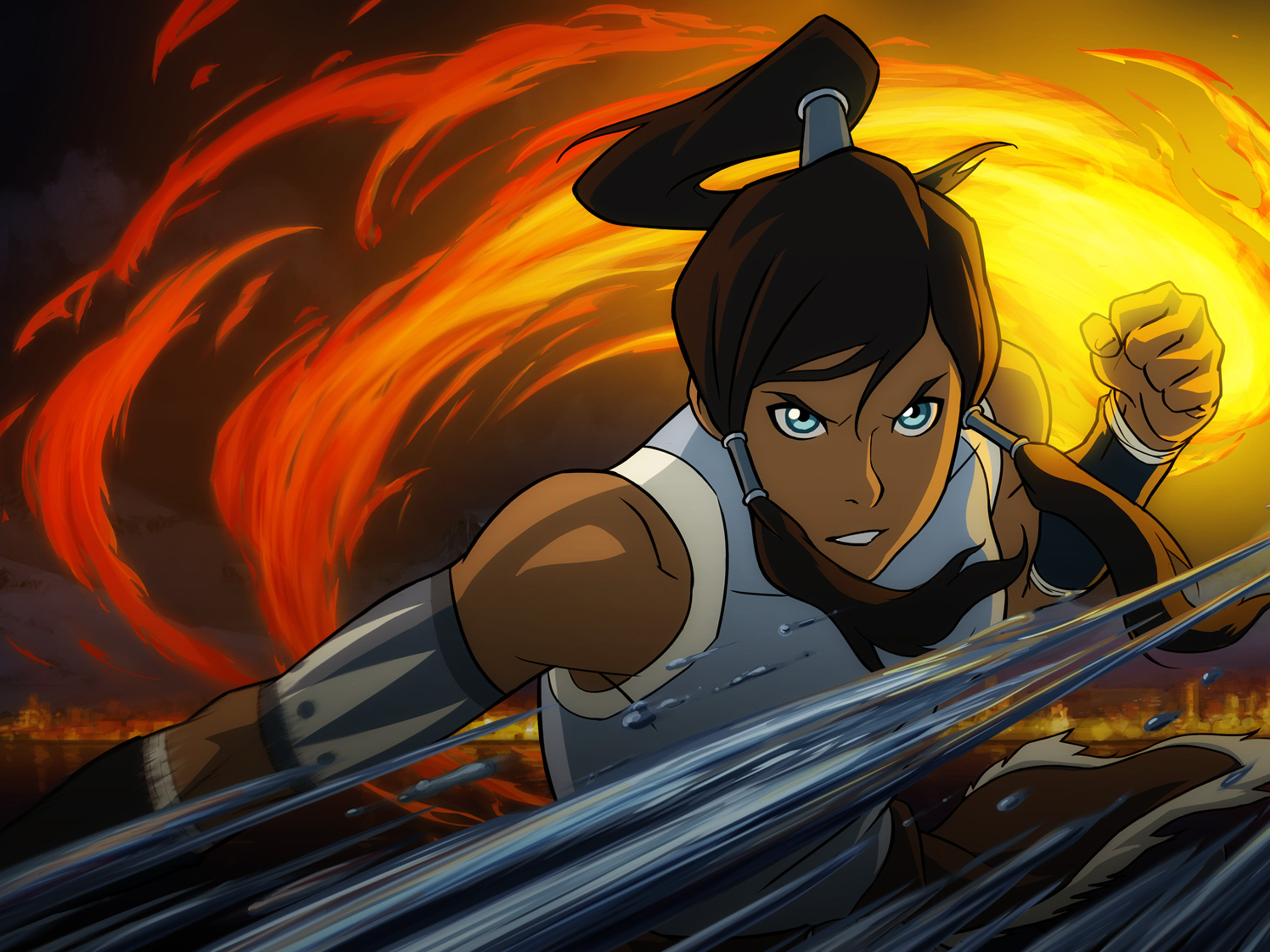
The animation in The Legend of Korra is beautiful, and I love how the series carries forward the legacy of Avatar: The Last Airbender. The fights are spectacular, and the original cast has become a group of legends whose influence is still felt throughout the world. What interests me most, though, is Korra’s loss of innocence as she begins to understand life beyond the world she grew up in.
A new generation
The story takes place seventy years after the end of the Hundred Year War. A lot has changed, but there are still familiar faces and connections to the original series. Katara is living in the Southern Water Tribe, where she has been Korra’s waterbending teacher and mentor. Toph’s legacy continues through her daughters, Lin and, later, Suyin. Aang’s son Tenzin lives on Air Temple Island with his family and becomes Korra’s airbending teacher. He also feels a responsibility to protect Republic City and help it grow, carrying forward his father’s vision for the United Republic. I love seeing how these characters and their families carry that history into a new generation.
Even when Aang is no longer there himself, his presence is everywhere. His statue is a reminder of the person he was and what he meant to the world. Republic City reflects the new world Aang and Zuko helped build through an agreement with Earth King Kuei. Seeing that legacy gives the series a connection to the original while leaving room for Korra to have her own story.
Korra’s introduction makes it clear how different her attitude toward being the Avatar is. At four years old, she is already ready to accept that responsibility and can bend three different elements. To me, being the Avatar feels like a calling for her, something she already sees as part of who she is, rather than a responsibility placed upon her. Aang struggled when he first learned he was the Avatar, while Korra eagerly embraces it. She wants to get out into the world, understand it better, and learn more about fighting and bending. That confidence is a strong part of what makes her interesting to me.
The action
I also love how that energy comes through in the action. The fight choreography feels stronger and weightier to me, with bending that really communicates the force behind each movement. That extends across the cast. Watching different characters use their abilities is spectacular, and the animation makes the action feel powerful. There is so much personality in the way people fight, which makes the bending exciting even when we are already familiar with the elements.
One of my favorite fights is the encounter with Zaheer where Korra and her father, Tonraq, fight alongside each other. Without giving away how it plays out, I love how the scene shows both of their incredible abilities and how well they work together as fighters. It is a great example of the choreography I enjoy so much in this series.
Korra losing her innocence
Underneath all that confidence, Korra has lived a sheltered life. Much of her upbringing has been spent training in an isolated compound in the Southern Water Tribe. She knows a lot about bending, but she has had limited experience with ordinary life beyond that environment. Arriving in Republic City means encountering people whose lives and concerns are very different from what she knows. Being eager to help does not automatically mean she understands what they need.
This is where the idea of lost innocence becomes important to me. Korra enters the world expecting her role as the Avatar to matter in a straightforward way. Instead, she finds a modern society where people question whether they need an Avatar at all. Officials can resist her interference, and ordinary people do not automatically trust her judgment. The tension between benders and nonbenders brings questions about power and inequality into the story. Her title cannot settle those questions for everyone.
I think that part of her journey can be relatable to people who have grown up with limited opportunities to connect with peers or experience the wider world. You can feel sure of yourself in a familiar environment and still be unprepared for how complicated life becomes outside it. Korra has to learn how to understand people who see things differently, including people who have no reason to treat her as someone special.
She also has to work out who she is, what she wants and what kind of Avatar she wants to become. Strength gives her a way to confront danger, but understanding other people takes experience and patience. Watching her develop the wisdom to listen and act as a mediator gives her journey meaning beyond the battles.
The writing and the wider world
My main criticism is that the writing sometimes falls short. I do not think it is as consistently well written or as in-depth as Avatar: The Last Airbender.
I still find a lot to appreciate in the new ideas the series explores. Learning about Wan, the first Avatar, gives us a look at the origins of the Avatar cycle and the spiritual history behind it. Harmonic Convergence connects that distant past to Korra’s time through an event that returns every ten thousand years. I like seeing how choices made so long ago continue to shape the world later Avatars inherit. That wider history gives me more to think about alongside Korra’s own journey.
My recommendation
The Legend of Korra is a show I recommend watching, especially after Avatar: The Last Airbender. Starting with the original lets you appreciate the people and history Korra builds on. Seeing their legacy in this series can also give you a greater appreciation for The Last Airbender itself.